
Spoken Word Poetry: Meaning, History, Elements and How to Write It
A spoken word poetry poem can look powerful on a page, yet sound completely different when a person stands in front of an audience and gives every line a voice. Spoken word poetry is built around that moment. The words, pauses, rhythm, expression, and presence of the performer work together to turn written language into a live experience. It can be personal, humorous, political, reflective, or deeply emotional, and it does not depend on one fixed subject or rhyme pattern.
This guide explains what spoken word poetry is, where the modern form comes from, what separates it from an ordinary poetry reading, and how techniques such as repetition, imagery, rhythm, direct address, and vocal control shape a performance. It also clears up the common confusion between spoken word and slam poetry, then gives beginners a practical way to write and perform their own work.
What Is Spoken Word Poetry?
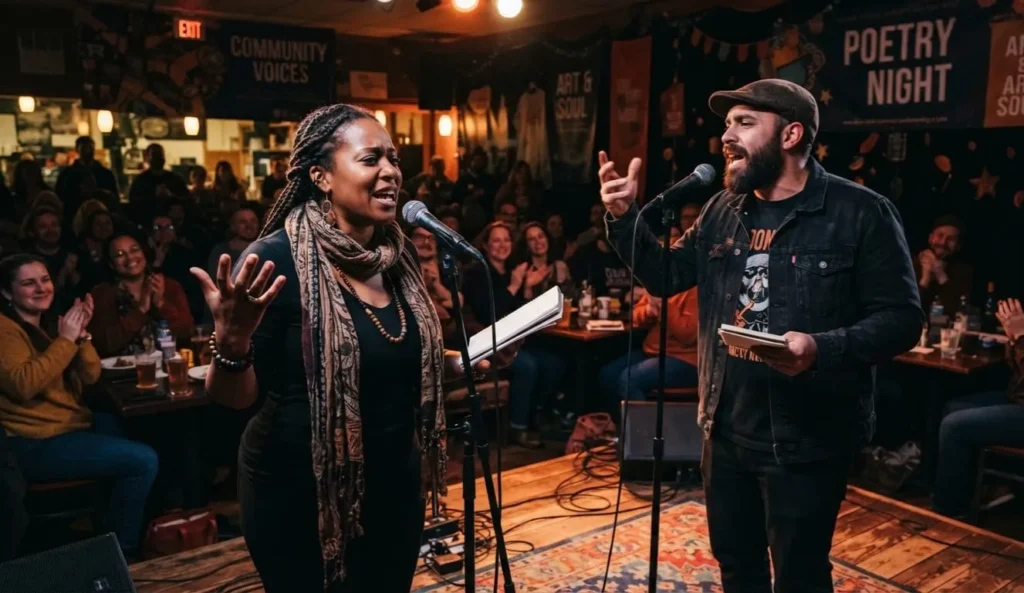
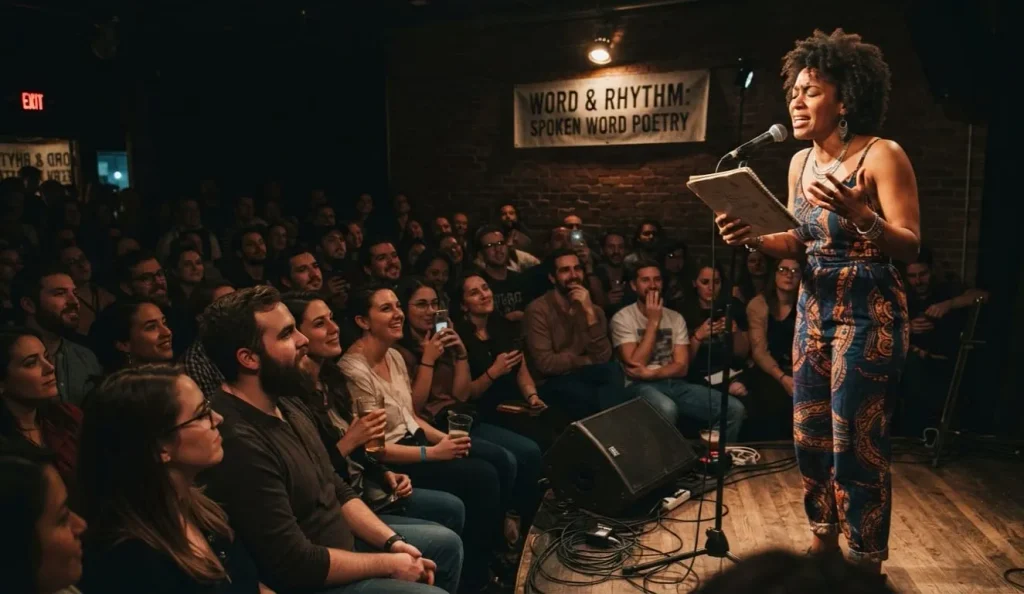
Spoken word poetry is poetry created with performance in mind. The poem may exist on a page, but its full effect depends on being heard. Voice, timing, emphasis, facial expression, gesture, and the relationship between performer and audience can all contribute to meaning.
The spoken word Poetry Foundation describes spoken word as a broad designation for poetry intended for performance. It notes that the form can include elements associated with rap, hip hop, storytelling, theater, jazz, rock, blues, and folk music. This broad definition matters because there is no single sound, subject, rhyme scheme, or stage style that every spoken word poet must follow.
A useful way to understand the form is to ask what happens when the poem leaves the page. A line may become stronger because the poet pauses before a key word. A repeated phrase may gradually change meaning as the performance becomes more intense. A simple sentence may feel intimate when spoken quietly and confrontational when delivered with force.
Spoken word therefore sits between literary writing and live performance. The language still matters, but the performance is not decoration added after the writing. It is part of the artistic experience.
How Spoken Word Poetry Developed
The idea of performing poetry is much older than the modern label. Human communities have used oral storytelling, songs, chants, recitation, and memorized verse for centuries. Poetry was often transmitted by listening and speaking before printed books became widely available.
Modern spoken word culture developed through many overlapping traditions rather than from one single starting point. Oral traditions, Black literary and musical cultures, political performance, storytelling, jazz, hip hop, community arts, and poetry readings all contributed to the environment in which contemporary spoken word grew.
In the United States, the Harlem Renaissance and later cultural movements helped expand forms of poetry that emphasized voice, identity, community, music, and public expression. The Last Poets and other performers connected poetry with social and political commentary, while later performance communities created spaces where poets could address audiences directly.
spoken word Poetry Foundation writing about the history of spoken word also emphasizes its social character. The form is not simply about reading a text aloud. It often depends on engagement between poet and listeners, which helps explain why live venues and community spaces have been important to its development.
Spoken Word Poetry and the Rise of Poetry Slam
spoken word Poetry slam is closely connected to spoken word, but the terms are not interchangeable. A slam is a competitive poetry event in which performers present poems and selected audience members or judges score them. The modern poetry slam movement is associated with Marc Smith and Chicago in the 1980s, and national slam competitions followed in the United States.
Spoken word poetry is the broader category. A poet can perform spoken word without competing in a slam, while a slam poet is performing within a particular competitive setting. Some poets move between both environments, but the purpose of the event changes the experience.
This distinction is useful for beginners. If you write a poem for an open mic, classroom presentation, community event, video, or personal performance, you do not need to turn it into a competition piece. The poem only needs to communicate effectively through voice and performance.
What Makes Spoken Word Poetry Different?
The strongest difference is the role of sound. On a printed page, readers control the pace. During a live performance, the poet controls timing and guides the audience through the emotional movement of the piece.
A spoken poem may use short sentences to create speed, long phrases to create flow, or silence to make a moment feel important. Repetition can give an audience something to remember. Direct address can make the poem feel like a conversation rather than a distant literary object.
Another difference is physical presence. Eye contact, posture, facial expression, hand movement, and movement across a stage can reinforce the message. These choices should support the poem rather than distract from it.
That does not mean every spoken word performance has to be dramatic. Quiet delivery can be just as effective as loud delivery when it matches the material. Good performance is not about acting as intensely as possible. It is about making deliberate choices that help the audience understand and feel the poem.
Key Elements of Spoken Word Poetry
There is no mandatory formula, but several techniques appear frequently in effective performance poetry. Understanding them helps writers decide what they want their audience to hear and remember.
Voice and Delivery
Voice is more than volume. Pitch, pace, emphasis, pauses, pronunciation, and changes in energy all affect meaning. A poet might slow down before an important idea or increase the pace when describing a moment of excitement.
Beginners often make the mistake of trying to sound powerful in every sentence. Constant intensity can make a performance feel flat because the audience has no contrast. A stronger approach is to create movement. Let calm sections remain calm and allow important moments to build naturally.
Rhythm and Sound
Spoken word poetry often relies on rhythm even when it does not follow a traditional meter. Repeated sounds, internal rhyme, alliteration, assonance, consonance, and carefully chosen word lengths can make a piece easier to hear and remember.
Read your draft aloud while writing. A line that looks elegant on the screen may feel awkward in the mouth. Conversely, a sentence that seems ordinary in writing can become memorable when its sounds and timing work well.
The goal is not to make every line rhyme. Sound should serve meaning. Forced rhyme can make a serious idea feel artificial, while a natural pattern of repeated sounds can give the performance musical energy.
Repetition
Repetition is one of the most useful tools in performance poetry because an audience hears a poem only once in a live setting. Repeating a word, phrase, question, or sentence structure gives listeners an anchor.
The important point is progression. If the same phrase returns without changing its emotional or contextual meaning, it can become predictable. If each repetition arrives after a new experience or argument, the phrase can gather weight.
Imagery and Metaphor
Strong imagery gives an audience something to picture. Instead of simply saying that a character feels nervous, a poet might describe hands that cannot stay still or a voice that disappears when a difficult question is asked.
Metaphor can turn an abstract idea into something concrete. Identity, fear, ambition, loneliness, memory, and hope are difficult to see directly, but an image can give them shape.
Choose images that belong to the speaker and situation. Specific details usually feel more convincing than a long collection of dramatic phrases.
Direct Address
Spoken word frequently speaks to someone. That person might be a parent, friend, teacher, stranger, institution, community, younger version of the poet, or even the audience itself.
Direct address creates immediacy because listeners can feel that the poem is happening in the room. Questions can also invite an audience to think rather than simply receive information.
Storytelling
A story gives a poem movement. It does not need a complicated plot. A short memory, conversation, discovery, conflict, or change in perspective can provide a beginning, middle, and ending.
When writing a story based poem, choose the moment that matters most. Too many background details can slow the performance. Give the audience enough information to understand the situation, then spend more space on the details that carry emotional or thematic meaning.
The Ending
A good ending does not always need a dramatic final sentence. It needs to feel earned. The final image, realization, question, or return to an earlier phrase should connect with what the poem has built.
Before deciding on the ending, ask what you want the audience to remember after the microphone is put down. That answer can help you remove lines that explain too much after the central idea is already clear.
How to Write Spoken Word Poetry
Writing a performance poem becomes easier when you separate the creative process into manageable stages.
Start With One Honest Idea
Choose one central idea rather than trying to discuss your entire life in one poem. You might begin with a memory, question, conflict, belief, place, relationship, or observation.
Write freely for a few minutes without worrying about rhyme. The first draft is for discovery. You are looking for the sentence or image that makes you think, this is what I really want to say.
Find the Emotional Center
Once you have material, identify the emotional center. What changes between the beginning and the end? What does the speaker understand at the end that was not understood at the beginning?
This does not have to be a complete transformation. Sometimes the change is simply a clearer question or a new way of looking at the same memory.
Build a Strong Opening
The first lines have a practical job. They need to give the audience a reason to keep listening. You can begin with a surprising image, a direct statement, a question, a specific moment, or a line that creates tension.
Avoid opening with a long explanation of what the poem will discuss. Let the poem demonstrate its subject through language and experience.
Write for the Ear
Read each section aloud. Listen for places where your breath naturally stops. Notice words that feel difficult to say. Remove phrases that exist only because they look good on the page.
Spoken writing benefits from clarity. The audience cannot reread a confusing sentence while you are performing it. If a key idea can be expressed more simply without losing its depth, simplicity is often the better choice.
Add Sound and Repetition
After the meaning is clear, listen for opportunities to strengthen sound. You might repeat a phrase, place similar sounds close together, or create a rhythm that reflects the subject.
Do not decorate every sentence. A few well placed sound patterns can be more memorable than constant wordplay.
Revise the Performance
The first draft is not the final performance. Record yourself reading the poem and listen without looking at the text. Ask whether the meaning is clear, whether the pace changes naturally, and whether the important moments are receiving enough space.
Then revise the writing and the delivery together. Sometimes a line needs to change. Sometimes the line is fine and the pause before it needs to change.
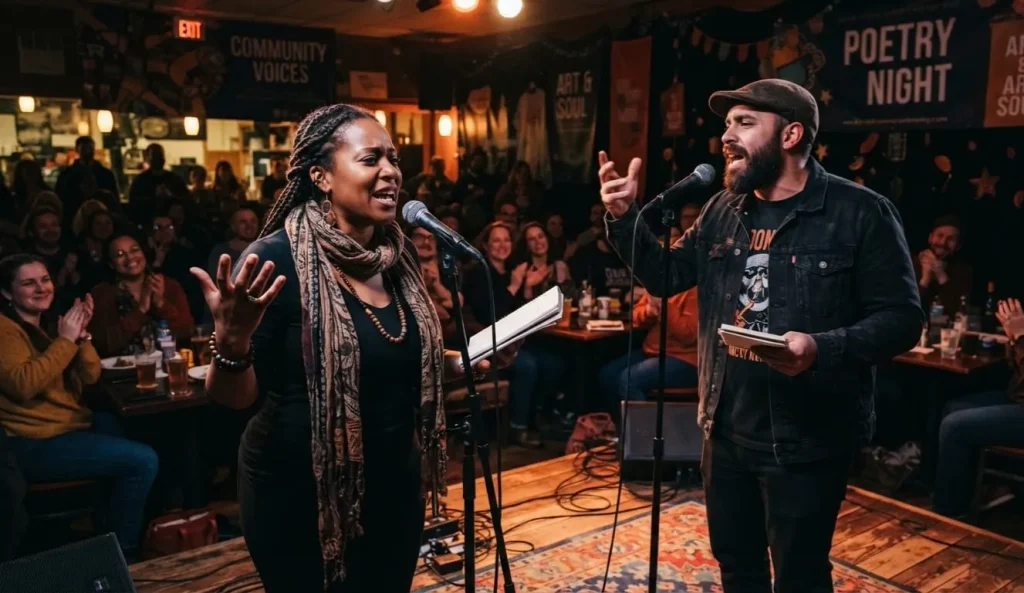
Spoken Word Poetry Performance Tips for Beginners
A first performance can feel intimidating, especially when the audience is close enough to see every movement. Preparation reduces that pressure.
Start by practicing the poem aloud several times. Then practice standing up and using the same posture you expect to use on stage. If possible, rehearse with the microphone or room setup you will actually use.
Mark natural pauses in your draft. You do not need to memorize every gesture. Instead, become familiar enough with the structure that you can keep going if you lose one word.
Keep your breathing steady. If the poem becomes fast, make sure the speed is a deliberate choice rather than the result of nervousness. Pauses can make you sound more confident and give the audience time to absorb important lines.
Eye contact can be useful, but do not force yourself to stare continuously at one person. Look up regularly, connect with different parts of the room, and return to your page when you need it.
Most importantly, remember that performance is communication. You do not need to imitate famous poets or adopt a particular dramatic voice. Your goal is to make your own poem understandable, engaging, and honest.
Common Themes in Spoken Word Poetry
Spoken word poetry can explore almost any subject. Personal identity, family, friendship, education, culture, love, grief, ambition, faith, inequality, politics, community, migration, memory, and everyday life are all possible subjects.
Social issues appear frequently because performance creates a direct space for public conversation. Poets have used spoken performance to discuss racism, inequality, gender, cultural identity, political power, and community experiences.
Personal subjects can be equally powerful. A poem about a family kitchen, a difficult conversation, a childhood memory, or a small daily habit can become meaningful when the details reveal something larger about the speaker.
The subject itself does not make a poem powerful. The depth of observation, specificity of language, structure, and performance determine how effectively the subject reaches an audience.
Spoken Word Poetry Versus Traditional Poetry
The difference is not that one form is real poetry and the other is not. The distinction is mainly about intended performance and how meaning is delivered.
A page focused poem may depend heavily on visual arrangement, punctuation, line breaks, typography, meter, or patterns that readers can examine at their own pace. A performance focused poem may place greater weight on sound, timing, repetition, gesture, and immediate audience response.
There is plenty of overlap. A written poem can be read aloud beautifully, and a spoken poem can be published on a page. Many poets work comfortably in both spaces.
Instead of treating the forms as opposites, it is more useful to think about where the poem is asking the audience to pay attention. If the experience depends strongly on hearing the poet speak, performance is likely central to the work.
Spoken Word Poetry and Social Connection
One reason performance poetry continues to attract audiences is its ability to create a shared experience. A reader can encounter a poem alone, while a live performance places the poet and listeners in the same physical or digital space.
Poetry Foundation discussions of spoken word have emphasized this social quality. Performance invites a response, whether that response is silence, laughter, applause, reflection, conversation, or disagreement.
This connection can be especially important for young writers and communities that do not always see their experiences represented in traditional literary spaces. Spoken word can offer a relatively accessible route into creative writing because the starting point is often a voice and a story rather than a strict poetic form.
Where Can You Perform Spoken Word Poetry?
Beginners can look for school literary events, community arts programs, open mic nights, poetry clubs, local cultural events, or online performance opportunities. Some writers also record readings for personal projects or social media.
Before performing, check the rules of the venue. Some events have time limits, content guidelines, registration requirements, or specific microphone arrangements.
A classroom can also be a useful starting point. Performing for a small group lets you learn how people respond to pacing, volume, humor, silence, and storytelling before moving to a larger stage.
How to Improve Your Spoken Word Poetry Over Time
Improvement usually comes from repeated practice rather than one perfect writing session. Read a wide range of poetry, listen to different performers, and pay attention to how each poet uses sound and silence.
Keep a notebook of observations. Write down interesting phrases, memories, questions, overheard details, and images. You do not need to turn every note into a poem. The purpose is to train yourself to notice material.
Record performances and review them later. Listen for places where you rushed, lost clarity, or used the same vocal pattern too often. Ask someone you trust what they remembered most. Their answer can reveal whether the poem’s central idea reached the audience.
Over time, you will develop a personal sense of rhythm, structure, and delivery. That is more valuable than memorizing a fixed formula.
Final Thoughts
Spoken word poetry is best understood as poetry that comes alive through performance. Its strength can come from the relationship between language and voice, but there is no single formula that defines a successful piece.
A strong performance poem usually has a clear reason for being spoken aloud. It uses sound, structure, imagery, repetition, storytelling, and delivery to make an idea easier to hear and remember. It can speak about private experience or public issues, and it can be quiet, humorous, angry, reflective, or energetic.
If you are beginning, start small. Choose one honest idea, write for the ear, read the draft aloud, revise what feels unnatural, and practice the performance. You do not need a perfect rhyme scheme or a dramatic stage persona. You need something meaningful to say and enough craft to help the audience hear it.
FAQs
What is spoken word poetry?
Spoken word poetry is poetry written or adapted for live or recorded performance. The meaning is shaped not only by the words but also by voice, rhythm, pauses, emphasis, and delivery. It can cover almost any subject and does not require one specific rhyme scheme or structure.
Is spoken word poetry the same as slam poetry?
No. Spoken word is a broad category of performance focused poetry. Slam poetry is usually performed within a competitive event where judges or audience members score the performances. A poet can perform spoken word without taking part in a slam.
Does spoken word poetry have to rhyme?
No. Rhyme can be useful, but it is optional. Spoken word can rely on repetition, rhythm, alliteration, assonance, imagery, storytelling, pauses, and natural speech patterns instead.
Can spoken word poetry be about any topic?
Yes. A poem can explore family, identity, friendship, education, culture, love, grief, ambition, politics, social issues, memory, or ordinary daily experiences. The quality of the poem depends more on how thoughtfully the subject is developed than on the subject itself.
How long should a spoken word poem be?
There is no universal length. A poem should be long enough to develop its central idea without repeating itself. If you are performing at an event, follow its time limit rather than trying to reach a particular word count.
Do I need to memorize a spoken word poem?
No. Some performers memorize their poems, while others use printed pages or notes. Memorization can increase eye contact and freedom of movement, but a well practiced reading can also be effective.
How can I make spoken word poetry sound natural?
Read your poem aloud while revising. Replace phrases that feel awkward to say, use punctuation or spacing to remind yourself where to pause, and allow your normal speaking voice to guide the delivery. Natural does not mean flat. It means the performance feels connected to the words.
What are the main techniques used in spoken word poetry?
Common techniques include repetition, rhyme, rhythm, alliteration, assonance, consonance, imagery, metaphor, direct address, storytelling, questions, changes in pace, and purposeful pauses. Not every poem needs all of them.
Can beginners write spoken word poetry?
Absolutely. Beginners can start with a personal memory, question, observation, or experience. Write freely first, then choose the strongest idea and shape the draft around it. Reading the poem aloud is one of the simplest ways to begin revising.
What makes a spoken word poetry performance powerful?
A powerful performance usually combines clear writing with intentional delivery. The poet knows what the poem is trying to communicate and uses pacing, emphasis, silence, expression, and voice to support that purpose. Authenticity and clarity are often more effective than exaggerated drama.
Can spoken word poetry be performed without music?
Yes. Music is optional. Many spoken word performances use only the poet’s voice and a microphone. Some performers add music, movement, projected visuals, or other elements, but the poem should remain understandable without them.
Where can I perform spoken word poetry?
Possible venues include school events, poetry clubs, community arts programs, open mic nights, cultural events, and online platforms. Beginners can start with a supportive small audience and gradually move toward larger events.
How do I choose a topic for my first spoken word poem?
Choose something you genuinely care about or have a strong observation about. A specific memory or question is often easier to develop than a huge topic. Instead of writing about life in general, begin with one moment that reveals something about your life or perspective.
What is the difference between reading a poem and performing it?
Reading mainly presents the written text, while performance uses the poet’s voice and physical presence as part of the experience. A performance may change pace, volume, emphasis, pauses, and expression to guide the audience through the poem.
Can spoken word poetry be used in school?
Yes. Spoken word can support creative writing, public speaking, literary analysis, confidence building, and classroom presentations. Students can study performance techniques and create original pieces without needing to follow a traditional poetic form.