Assonance in Poetry: How Repeated Vowel Sounds Shape a Poem
A poem can sound connected even when its words do not rhyme. Read a few lines aloud and you may notice that certain vowel sounds keep returning, almost like quiet notes beneath the language. That recurring sound can make a line feel calm, tense, playful, mournful or memorable without announcing what it is doing. This is where assonance in poetry becomes especially useful.
Assonance in poetry is easy to miss because it is based on sound rather than spelling. Two words can use different letters and still share a vowel sound, while two words that look similar on the page may not create the same effect when spoken. Understanding that distinction helps readers analyse poems more accurately and gives writers a flexible way to shape the sound of their own lines.

What Is Assonance in Poetry?
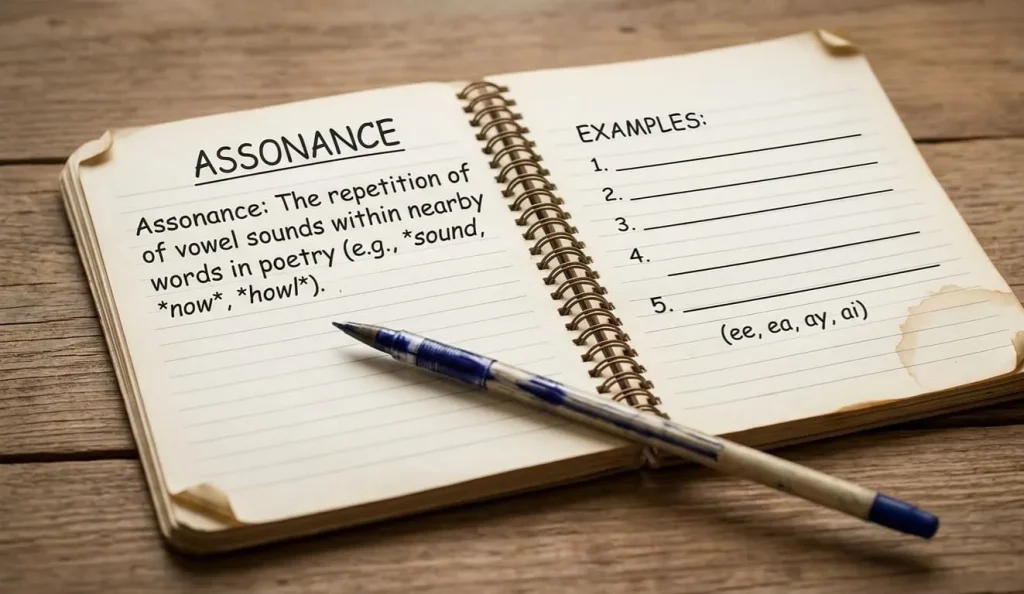
Assonance in poetry is the repetition of similar vowel sounds in nearby words. The repeated sound may appear at the beginning, middle or end of a word, and the surrounding consonants do not need to match. What matters is that the repeated vowel sound is close enough for the reader or listener to notice it. The Poetry Foundation and the Academy of American Poets both describe assonance as repetition of vowel sounds, with the Academy emphasize the audible quality of the repetition.
Consider a simple phrase such as “slow road home.” The long o sound appears several times, while the consonants change from word to word. That repeated vowel creates an internal connection without requiring a conventional end rhyme. In poetry, this kind of sound pattern can sit quietly beneath meaning, helping separate words feel related even when they are not grammatically or visually connected.
The key is sound, not the individual vowel letter. For example, different spellings can represent the same vowel sound in English. A poet may therefore create assonance with words that look unrelated. This is one reason it is better to read a suspected example aloud rather than simply underline repeated letters.
How Assonance Works in a Poem
Assonance in poetry works through proximity and recurrence. A single vowel sound appearing once is simply part of normal speech, but the same sound returning in nearby important words can become noticeable. The effect may be strongest in stressed syllables, although definitions can vary in how strictly they treat stress and distance. A practical reader can ask whether the sound is close enough and prominent enough to register as a deliberate pattern.
Poets can place assonance inside a line, across several lines, or around important words. Because it does not require matching consonants, it leaves more freedom than perfect rhyme. A writer can choose a word for its meaning and still connect it sonically to another word through a shared vowel sound.
The result is often described as musicality, but musicality is not the only purpose. Repeated vowels can draw attention to a key phrase, slow or quicken the perceived movement of a line, support a mood, or help a sequence of words feel cohesive. The exact effect depends on the vowel, the surrounding consonants, rhythm, syntax, context and the poem as a whole.
Why Poets Use Assonance in Poetry
Poets rarely use sound devices only because they sound attractive. A repeated vowel can support an idea or emotional atmosphere while remaining less obvious than a strict rhyme scheme. The Poetry Foundation describes assonance as a sonic technique that belongs alongside devices such as alliteration and repetition, while the Academy of American Poets highlights the audible repetition itself.
Creating Rhythm and Flow
Repeated vowels can give a line a sense of continuity. When the same sound appears at meaningful points, the reader may feel an internal pulse even if the poem has no fixed rhyme scheme. This can be particularly useful in free verse, where sound patterns can provide cohesion without forcing every line into a predetermined structure.
Building Mood
Vowel sounds can contribute to mood, but they should not be treated as having one fixed emotional meaning. A long vowel may feel spacious in one context and heavy in another. A short vowel may create energy or sharpness, yet the surrounding words can completely change the impression. Good analysis therefore connects the repeated sound to the poem’s imagery, subject, rhythm and tone instead of claiming that a particular vowel always creates one emotion.
Emphasizing Important Words
A poet can repeat a vowel around words that carry the emotional or thematic weight of a passage. Because the sound links those words, readers may sense a relationship before consciously identifying it. This can be especially effective when a poem returns to a central image or idea several times.

Assonance in Poetry Examples
The clearest way to understand assonance is to listen for it in context. The following examples are original teaching examples, so they demonstrate the technique without reproducing long passages from copyrighted poems.
Example 1: Repeated Long O Sound
“The slow boat rolled home through the cold.” The long o sound appears in slow, boat, rolled, home and cold. The consonants change, so the words are not simply repeating the same ending. The recurring vowel gives the sentence a rounded, flowing quality that suits the image of a boat moving steadily through water.
Example 2: Repeated Long E Sound
“Green leaves lean toward the evening breeze.” The long e sound links green, leaves, lean and evening. The repeated vowel helps the line feel connected and sustained. Notice that the effect does not depend on every word containing the same spelling. Sound is the feature that matters.
Example 3: Repeated Short A Sound
“Black branches crack in the afternoon.” The short a sound in black, branches and crack creates a tighter internal pattern. The effect is more noticeable when the repeated sound appears in words that are close together and important to the image.
Example 4: Assonance Across a Line
“I watch the rain fade into the grey.” Here, the repeated long a sound appears in rain, fade and grey. The pattern does not form a perfect rhyme, but it creates a subtle link between the words. This shows why assonance can be useful when a poet wants musical connection without obvious end rhyme.
Assonance in Famous Poetry
Established poems provide valuable evidence because their sound patterns can be studied alongside meter, rhyme, imagery and historical context. The Academy of American Poets discusses assonance in Alfred Lord Tennyson’s “The Lotos Eaters,” pointing out recurring vowel sounds across nearby words. The example demonstrates that assonance can operate through several different vowel spellings and positions within a line.
Edgar Allan Poe is also frequently discussed for his dense use of sound patterns. His poetry often combines assonance with rhyme, consonance, alliteration and repetition, making it difficult to isolate one device as the sole reason for a line’s musical effect. This is an important lesson for analysis: a poem can use several sound devices at the same time.
William Wordsworth’s “I Wandered Lonely as a Cloud” is another commonly discussed example. Readers can hear recurring vowel sounds across words such as cloud, crowd and golden. The poem also uses end rhyme and meter, so the assonance works as one layer within a larger sound structure rather than functioning alone.
Assonance Versus Rhyme
Assonance and rhyme are related, but they are not identical. Assonance focuses on repeated vowel sounds that can occur anywhere in nearby words. Rhyme generally involves matching sounds at the ends of words, often including the vowel and the consonant sounds that follow it. Because of this, a pair of rhyming words can also contain assonance, but not every pair showing assonance forms a rhyme.
For example, “lake” and “late” share the long a vowel, so they can illustrate assonance, but their final consonants differ. By contrast, “lake” and “make” have matching ending sounds and form a rhyme. This distinction is useful when analysing a poem with a strong rhyme scheme because the vowel repetition may still be doing additional work inside the lines.
Assonance Versus Alliteration
Alliteration normally concerns the repetition of initial consonant sounds in nearby words, whereas assonance concerns repeated vowel sounds. The Poetry Foundation defines alliteration in terms of repeated initial stressed consonant sounds. In a phrase such as “wild winds,” the repeated w sound is alliterative. In a phrase such as “slow road home,” the repeated long o sound is an example of assonance.
The two devices can appear together. A poet might repeat an initial consonant while also repeating a vowel sound inside the same group of words. When that happens, it is better to identify each sound pattern separately rather than treating all repetition as alliteration.
Assonance Versus Consonance
Consonance is the repetition of consonant sounds, while assonance is the repetition of vowel sounds. The repeated consonant in consonance can occur at different positions within words. This makes consonance broader in placement than the initial sound pattern associated with alliteration.
The distinction becomes simple when you listen for the type of sound that returns. If the recurring feature is a vowel, think assonance. If the recurring feature is a consonant, think consonance. A poem can use both at once, creating a layered sound texture.
How to Identify Assonance in Poetry
Start by reading the poem aloud at a natural pace. Do not begin by searching for identical vowel letters. Instead, listen for vowel sounds that seem to return in nearby words. Once you hear a possible pattern, write the words down and compare their pronunciation.
Next, check the distance between the words. A repeated sound scattered randomly across a long poem may not be meaningful as a local example of assonance. Look for clusters, especially around stressed or semantically important words. Then examine the surrounding consonants. If the vowel sound repeats while the consonants change, you may be hearing assonance rather than full rhyme.
Finally, ask what the pattern contributes. Does it connect images? Does it make a line smoother? Does it support a mood? Does it highlight a word that matters to the poem? If the sound pattern has no clear relationship to the passage, avoid forcing an interpretation. Sometimes repeated sounds occur naturally because English has recurring phonetic patterns.
How to Use Assonance in Your Own Poetry
Begin with meaning rather than sound. Decide what you want the line to say, then notice which important words already share a vowel sound. From there, you can adjust word choice to strengthen the pattern without making the sentence feel unnatural. This keeps the device subordinate to the poem instead of making the poem feel engineered around one sound.
Reading aloud is essential. A line that looks elegant on the page may sound awkward when spoken, while a subtle vowel pattern can become obvious once you hear it. Try several versions of the same line and listen for the balance between meaning, rhythm and sound.
Do not force every nearby word to contain the same vowel. Too much repetition can make a passage feel predictable. Strong assonance often works because it is selective. The repeated sound guides the ear without becoming the only thing the reader notices.
Common Mistakes When Analysing Assonance in poetry
One common mistake is looking only at spelling. English vowel sounds can have several spellings, so identical letters are not required. Another mistake is assuming that every repeated vowel in a poem is deliberate. Sound repetition is common in natural language, and analysis should consider proximity, prominence and context.
A third mistake is calling any pair of rhyming words assonance without explaining the difference. A rhyme can include repeated vowel sounds, but its defining feature concerns matching sounds at word endings. When writing a literary analysis, identify the broader sound relationship and then explain the specific role played by the vowel repetition.
A final mistake is assigning a fixed emotional meaning to one vowel. Claims such as “the long o sound always means sadness” are too absolute. Sound can influence perception, but meaning comes from the complete combination of sound, word choice, rhythm, imagery, context and subject.
Does Assonance in poetry Always Need to Be Intentional?
Not necessarily. A reader can identify an assonant pattern even when the poet may not have consciously planned every repeated sound. In literary analysis, the more useful question is whether the pattern is noticeable and whether it contributes meaningfully to the reading. A strong interpretation should be supported by the actual language and structure of the poem.
For poets, however, intentional use can be valuable. Writers can revise lines to create a stronger sound relationship when it supports the desired rhythm or mood. The goal is not to make every repeated vowel obvious. The best use often feels natural enough that readers experience the effect before naming the technique.
Assonance in poetry and Free Verse
Free verse does not depend on a fixed rhyme scheme or regular meter, which makes internal sound patterns especially useful. Assonance can create cohesion between lines while preserving conversational syntax and flexible line lengths. It gives the poet another way to organize a poem without forcing every ending to match.
This does not mean free verse must contain assonance. Sound patterns should serve the poem’s purpose. A poem built around silence, fragmentation or abrupt changes may deliberately avoid sustained repetition. Assonance is a tool, not a requirement for successful poetry.
Assonance in Songwriting and Spoken Language
Assonance in poetry is not limited to printed poetry. It also appears in songs, speeches, advertising language and everyday phrases. Repeated vowel sounds can make a phrase easier to remember and can help spoken language move smoothly. In performance, the effect may become stronger because the voice can stretch, stress or emphasize particular vowels.
Songwriting can make the relationship between assonance and rhyme especially clear. A lyric can repeat a vowel across several words while changing the final consonants, giving the performer more freedom than a strict rhyme scheme would allow. This is one reason sound based analysis should listen to the complete line rather than looking only at word endings.
A Simple Method for Writing an Assonant Line
Choose one idea and write a plain sentence about it. Circle two or three words that carry the meaning. Say them aloud and notice their vowel sounds. If they share a sound naturally, build the sentence around them. If they do not, search for alternative words that preserve the meaning while creating a subtle vowel connection.
Then read the line several times. Remove any word that feels unnatural merely because it fits the sound. A poem should not sacrifice precision for a decorative effect. If the sound pattern survives after unnecessary words are removed, it is more likely to feel intentional and convincing.
Finally, place the line beside the lines around it. Assonance can become more effective when it creates a sound relationship across a short passage rather than appearing as an isolated trick. Look for repetition that supports the poem’s larger movement.
Final Thoughts
Assonance in poetry is one of poetry’s quieter sound devices, but quiet does not mean unimportant. By repeating vowel sounds across nearby words, a poet can create internal links that shape rhythm, atmosphere, emphasis and musicality without relying on perfect rhyme. The technique works best when it supports the meaning of the poem instead of competing with it.
When you analyse assonance, listen before you label. When you write with it, choose meaning before sound and then let sound refine the line. That approach keeps the device natural, flexible and useful across formal poetry, free verse and spoken language.
FAQs
What is assonance in poetry?
Assonance in poetry is the repetition of similar vowel sounds in nearby words. The repeated sounds can occur at different positions within words, and the surrounding consonants do not have to match. Poets use the pattern to create internal musicality, rhythm, emphasis or cohesion.
What is a simple example of assonance in poetry?
A simple example is “slow road home,” where the long o sound repeats in nearby words. The consonants differ, so the phrase does not depend on identical word endings. The repeated vowel gives the short phrase a connected sound.
What is the difference between assonance and rhyme?
Assonance in poetry focuses on repeated vowel sounds and can occur inside words or at their edges. Rhyme generally depends on matching sounds at the ends of words. A rhyming pair may contain assonance, but assonance does not automatically create a rhyme.
What is the difference between assonance in poetry and alliteration?
Assonance in poetry repeats vowel sounds, while alliteration normally repeats initial consonant sounds in nearby words. For example, repeated long o sounds in “slow road” illustrate assonance, while repeated initial w sounds in “wild winds” illustrate alliteration.
What is the difference between assonance in poetry and consonance?
Assonance repeats vowel sounds. Consonance repeats consonant sounds, which can appear at different positions within words. Both can create musical links between words, and poets often use them together.
Why do poets use assonance in poetry?
Poets use assonance in poetry to connect words through sound, strengthen rhythm, support mood, emphasize important ideas and create musicality without relying entirely on end rhyme. Its subtle quality makes it useful in both formal poetry and free verse.
Can assonance in poetry occur at the beginning of a word?
Yes. Assonance in poetry is based on repeated vowel sounds rather than a fixed word position. A repeated vowel can occur at the beginning, middle or end of nearby words, provided the sound pattern is noticeable in context.
Does assonance in poetry depend on spelling?
No. Assonance in poetry depends on pronunciation rather than identical vowel letters. Different spellings can represent the same vowel sound in English, so reading the words aloud is a reliable way to check a suspected pattern.
Is every repeated vowel sound an example of assonance in poetry?
Not necessarily. Repeated vowels occur naturally in language. A useful example of assonance in poetry usually involves nearby or prominent words where the repeated sound is noticeable and contributes to the passage’s sound or meaning.
Can assonance in poetry appear in free verse?
Yes. Free verse often uses internal sound patterns such as assonance in poetry to create cohesion without a fixed rhyme scheme. The poet can repeat a vowel sound across a line or passage while keeping flexible line lengths and natural syntax.
Can a poem use assonance and rhyme at the same time?
Yes. A poem can use vowel repetition inside lines while also using end rhyme. In fact, several sound devices may operate at once. Good analysis should identify each pattern separately and explain how the patterns work together.
How can I find assonance in a poem?
Read the poem aloud and listen for recurring vowel sounds in nearby words. Write down the words that seem connected, compare their pronunciation and then consider whether the pattern supports rhythm, mood, emphasis or another feature of the poem.
Is assonance only used in poetry?
No. Assonance also appears in prose, speeches, slogans and songs. Poetry makes the device especially noticeable because poets deliberately work with rhythm, sound and line structure, but the underlying sound technique can occur in many forms of language.
Can assonance change the mood of a poem?
It can contribute to mood, but no vowel sound has one universal emotional meaning. The effect depends on context, rhythm, imagery, consonants and the surrounding words. Strong analysis explains the sound pattern in relation to the whole passage.
How can I use assonance when writing poetry?
Start with the meaning you want to express, then look for important words that already share a vowel sound. You can revise nearby wording to strengthen the connection, but avoid forcing unnatural vocabulary just to repeat a sound. Reading the finished line aloud helps you judge the result.