

Introduction
Read a poem aloud and you may notice something before you can explain it. Some lines seem to move like footsteps, some feel gentle and flowing, and others arrive in short bursts that demand attention. That movement is not created by rhyme alone. Rhythm in poetry comes from the way sounds, stresses, pauses, repetitions, and line movement are arranged, giving the poem a distinctive voice and pace.
Understanding rhythm becomes much easier when you stop thinking of it as a rigid beat that every poem must follow. Formal poetry may use a regular metrical pattern, while free verse can create rhythm through speech patterns, repeated sounds, syntax, line breaks, and pauses. The Academy of American Poets distinguishes meter as a measured pattern while describing rhythm as the more fluid movement of living speech. citeturn0search2turn1search5
This guide explains rhythm in poetry from the ground up. You will learn how stressed and unstressed syllables work, how poetic feet form larger meters, how rhythm differs from meter and rhyme, why poets use rhythmic variation, and how to identify rhythm when reading a poem. The goal is not simply to memorize terminology. It is to hear what the poem is doing and understand why that sound matters.

What Is Rhythm in Poetry
Rhythm in poetry is the audible pattern created by the movement of stressed and unstressed syllables and the intervals between stresses. The Poetry Foundation defines rhythm as an audible pattern in verse established by the intervals between stressed syllables. This makes rhythm something you can hear as well as analyze on the page. citeturn1search8
A useful way to think about it is to compare poetry with ordinary speech. When people talk, they naturally emphasize some words, soften others, pause, speed up, slow down, and group phrases together. Poets can shape those same features deliberately. The result may be regular, irregular, musical, conversational, urgent, calm, playful, or tense.
Rhythm is therefore broader than simply counting syllables. Repeated words, recurring sounds, syntax, punctuation, line length, caesura, and enjambment can all influence the way a poem moves. The Academy of American Poets notes that syntax can help construct a poem’s rhythm through the arrangement and sound of words, while enjambment can add rhythmic variety by carrying meaning across line breaks. citeturn0search5turn0search2
How Rhythm in Poetry Is Created
The most familiar source of poetic rhythm is stress. A stressed syllable receives greater emphasis in speech, while an unstressed syllable receives less. When poets arrange these stronger and weaker beats in recurring patterns, readers can begin to hear a recognizable movement. Those recurring patterns are commonly described through metrical feet.
A poetic foot is a small unit of stressed and unstressed syllables. Several feet combine to form a line of meter. For example, an iamb contains an unstressed syllable followed by a stressed syllable. Five iambs in a line create iambic pentameter. Cambridge describes an iamb as a unit of poetic rhythm with an unstressed syllable followed by a stressed syllable. citeturn2search7
Not every line will sound perfectly mechanical, even when it follows a meter. Natural speech contains different levels of emphasis, and skilled poets often vary a regular pattern to prevent monotony or to highlight an important word. The Academy of American Poets explains that actual poetic rhythm can differ from an abstract metrical pattern because stress changes with syntax, context, and ordinary speech. citeturn0search2
Common Feet That Shape Rhythm in Poetry
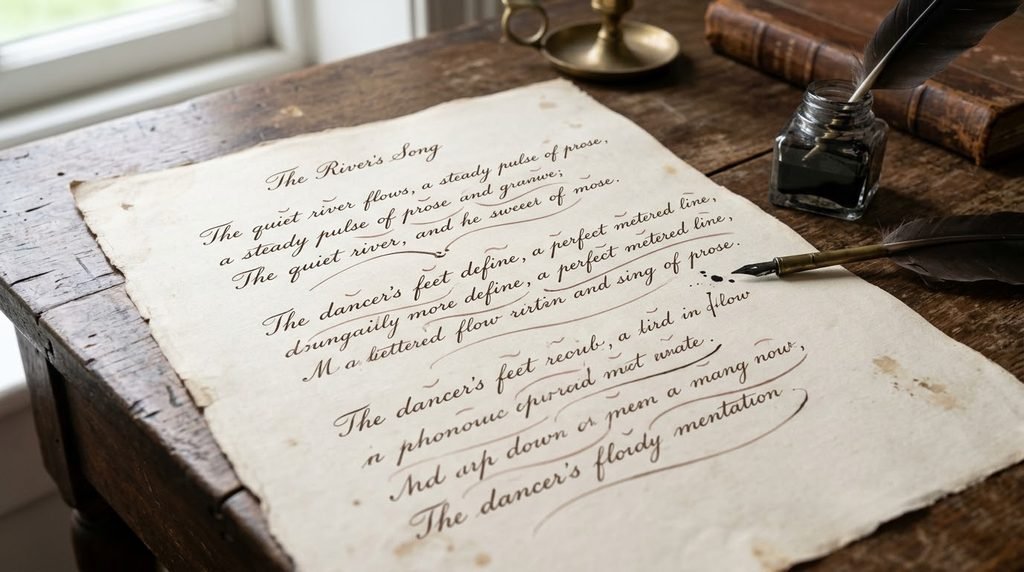
The names of poetic feet may look technical at first, but they become much simpler when you focus on the order of stress. The five most useful feet to recognize in English poetry are the iamb, trochee, anapest, dactyl, and spondee. Each creates a different basic movement, although its final effect always depends on the surrounding words and the poem as a whole.
Iambic Rhythm in Poetry
An iamb follows an unstressed and stressed pattern, often represented as da DUM. The movement rises toward the stronger syllable. Iambs are extremely common in English verse and appear in many forms, including iambic pentameter. Shakespeare’s sonnets are a familiar example of poetry built around iambic pentameter, although real lines contain rhythmic variations rather than sounding like a perfectly repeated machine beat.
Iambic movement can feel steady and conversational because it resembles many ordinary English word and phrase patterns. That does not mean every iambic poem sounds calm. Context, punctuation, vocabulary, and variation can make the same underlying meter sound forceful, nervous, solemn, or dramatic.
Trochaic Rhythm in Poetry
A trochee reverses the iambic pattern. It begins with a stressed syllable and moves to an unstressed syllable, often represented as DUM da. This is sometimes called falling rhythm because the stress arrives at the beginning of the foot. Trochaic patterns can produce a strong opening pulse and may sound emphatic or chantlike.
A well known example is Edgar Allan Poe’s use of trochaic movement in The Raven. The poem’s heavy opening stresses contribute to its dark musical quality. The important point is not that trochees always create a dark mood, but that a falling stress pattern gives a poet a different rhythmic tool from an iamb.
Anapestic Rhythm in Poetry
An anapest contains two unstressed syllables followed by a stressed syllable, represented as da da DUM. Because the main beat arrives after two lighter syllables, anapestic movement can create a rolling or forward moving effect. It is common in humorous verse, narrative poetry, and passages that benefit from a lively pace.
Edgar Allan Poe’s Annabel Lee provides a useful example of anapestic movement mixed with other rhythmic patterns. Such variation matters because poets do not always maintain one foot from beginning to end. A poem can establish a rhythmic expectation and then bend it to reflect a change in thought or emotion.
Dactylic Rhythm in Poetry
A dactyl is the reverse of an anapest. It contains one stressed syllable followed by two unstressed syllables, represented as DUM da da. The pattern begins with a strong beat and then moves away from it. Dactylic movement can create a rolling, expansive, or ceremonial effect, depending on the words and larger meter.
Alfred Lord Tennyson’s The Charge of the Light Brigade is often discussed for its energetic rhythmic movement. The repeated forward motion of the verse helps evoke the charge itself. This is a useful reminder that rhythm can imitate action. A poem does not merely describe movement through vocabulary; its sound can participate in the description.
Spondaic Rhythm in Poetry
A spondee contains two stressed syllables. It is less often used as the sole pattern for an entire English poem than as a variation inside another meter. Because two strong beats arrive together, a spondee can slow the reader or give special weight to a phrase. Poets may use it when a particular word or idea needs extra emphasis.
The value of a spondee often comes from contrast. If a poem has established a light alternating pattern, two strong syllables can suddenly make a phrase feel heavier. This is one reason rhythmic analysis should look for departures from the dominant pattern rather than treating every line as if it must be perfectly uniform.
Rhythm in Poetry and Meter: What Is the Difference
Rhythm and meter are closely related, but they are not identical. Meter is a structured pattern of poetic stresses, while rhythm is the broader movement created by stress, timing, sound, syntax, pauses, repetition, and other features. The Academy of American Poets describes meter as a measured pattern of rhythmic accents, while its discussion of prosody treats rhythm as part of the larger study of poetic sound and movement. citeturn1search5turn1search10
Think of meter as a framework and rhythm as the living performance inside that framework. A poem written in iambic pentameter has an underlying metrical design, but the actual reading can contain pauses, changes in emphasis, substitutions, and syntactic turns. Those details give the poem its individual voice.
This distinction also explains why free verse can have rhythm. Free verse does not depend on a fixed metrical pattern, but it can still have strong cadence, recurring stresses, repeated sounds, deliberate line breaks, and speech based movement. The Poetry Foundation describes cadence as the patterning of rhythm in natural speech or in poetry without a distinct meter. citeturn1search11
Rhythm in Poetry and Rhyme: Why They Are Not the Same
Rhyme concerns the correspondence of sounds, usually at the ends of lines or within lines, while rhythm concerns the movement of stresses, sounds, pauses, and timing. A poem can rhyme without having a strong regular meter, and a poem can have a powerful rhythm without using end rhyme. The Academy of American Poets defines rhyme separately from meter, which helps clarify why the two terms should not be treated as synonyms. citeturn1search5
Rhyme can still affect rhythm because repeated sounds create expectation. Repetition works in a similar way. When a word, phrase, sound, or line returns, the reader begins to anticipate its recurrence. The Academy of American Poets notes that repetition is a fundamental poetic technique and can help create memorable and incantatory effects. citeturn1search6
Why Rhythm in Poetry Matters
Rhythm gives a poem a physical quality. Readers do not only process the meaning of individual words; they also experience how quickly or slowly those words arrive, where the voice seems to lean, and where it pauses. A carefully shaped rhythm can make a line easier to remember, more satisfying to speak, or more emotionally persuasive.
Rhythm can also reinforce meaning. A quick succession of stresses may create urgency, while longer phrases and softer movement can encourage reflection. A sudden pause may make a word feel important. A repeated pattern can create stability, while a disruption can signal conflict or surprise.
The relationship between rhythm and meaning is not a fixed dictionary rule. An iamb does not automatically mean happiness, and a trochee does not automatically mean sadness. The effect comes from the interaction between rhythm, vocabulary, syntax, sound, imagery, and context. Strong analysis explains that interaction instead of assigning one emotion to every metrical pattern.

Other Elements That Influence Rhythm in Poetry
Line Length
Long lines can create an expansive or flowing movement, especially when the syntax carries the reader forward. Short lines can create sharper stops and stronger visual emphasis. Line length does not determine rhythm by itself, but it changes the amount of time and space a reader experiences before reaching the next break.
Caesura
A caesura is a noticeable pause within a line. It may be marked by punctuation, but it can also arise from syntax or a natural break in speech. A strong internal pause can interrupt an expected movement, create suspense, or give a phrase extra weight. Because rhythm depends on timing, pauses are part of rhythmic design.
Enjambment
Enjambment occurs when a sentence or phrase continues beyond the end of a poetic line without a strong grammatical pause. It encourages the reader to move across the line break rather than stopping completely. This can create acceleration, uncertainty, surprise, or a sense of continuous thought. citeturn0search7turn0search2
Alliteration and Assonance
Repeated consonant sounds and repeated vowel sounds can reinforce a poem’s musical texture. These devices do not create meter on their own, but they can make particular sound patterns more noticeable. When a poet combines them with stress, repetition, and line breaks, the result can be a strong rhythmic surface even in free verse.
Syntax and Word Order
The grammatical arrangement of words affects where a reader naturally pauses and which words receive emphasis. The Academy of American Poets explains that syntax can construct rhythm through the way words are arranged and sounded together. This means rhythm can be shaped by sentence structure even when a poem does not follow a traditional meter. citeturn0search5

How to Identify Rhythm in Poetry
You do not need to begin with complicated notation. Start by reading the poem aloud at a natural pace. Listen for words that receive extra emphasis and notice where your voice pauses, speeds up, or slows down. Reading aloud is especially useful because rhythm is an audible feature, not only a visual pattern on the page. citeturn1search8turn1search3
Next, mark a few stressed and unstressed syllables in one or two lines. Do not assume that every syllable must fit a perfect alternating pattern. English speech contains different levels of stress, and poetic rhythm often includes variation. Look for the dominant movement first, then identify places where the poet changes it.
After that, count the feet if the poem appears to use regular meter. Two feet make dimeter, three make trimeter, four make tetrameter, five make pentameter, six make hexameter, and so on. Then name the dominant foot. For example, five iambs per line create iambic pentameter.
Finally, look beyond the meter. Examine punctuation, line breaks, repeated sounds, repeated words, sentence structure, and stanza shape. Ask what the rhythm makes you feel and why. A strong interpretation connects the sound pattern to the poem’s meaning instead of stopping after identifying a technical label.
A Simple Rhythm in Poetry Analysis Example
Imagine a short line that moves with an unstressed syllable followed by a stressed syllable several times. You might hear a rising pattern that feels steady and balanced. If the same line suddenly places two strong syllables together, the change may make those words feel more forceful. The important observation is not simply that the pattern changed, but that the change affects emphasis.
Now imagine a free verse poem with no consistent meter. It may still repeat a three beat phrase, use short lines during a tense moment, and switch to long flowing sentences during reflection. The poem has rhythm even without a fixed metrical scheme. Its structure comes from patterns that are more flexible and speech based.
Examples of Rhythm in Poetry
Shakespeare’s sonnets are useful for studying iambic pentameter because the underlying pattern is clear while the individual lines remain expressive. Reading a line aloud can reveal how the expected alternating movement interacts with natural English emphasis. This makes Shakespeare especially useful for understanding the difference between a metrical framework and the actual rhythm a reader hears.
Edgar Allan Poe offers another useful contrast. The Raven uses strongly patterned sound and stress to create a memorable, dark musical quality. Annabel Lee uses a rolling combination of rhythmic patterns that supports its narrative voice. These examples show that rhythm can become part of a poem’s identity, not merely a technical feature hidden underneath the words.
Gerard Manley Hopkins developed what he called sprung rhythm, a system based on a fixed number of stressed syllables while allowing the number of unstressed syllables to vary. His letters describe scanning by accents or stresses rather than treating every line as a simple repeated sequence. This approach demonstrates how poets can build regularity around stress while keeping the surface closer to natural speech. citeturn0search3
Free verse provides a different lesson. The absence of a fixed meter does not mean the absence of craft. Cadence, repetition, syntax, lineation, sound patterns, and pauses can produce an intentional rhythmic structure. The Academy of American Poets discusses free verse as poetry in which rhythm can operate without a fixed metrical norm. citeturn0search2
How to Use Rhythm in Poetry When Writing
Start by reading your draft aloud. If a line feels awkward, your ear may detect the problem before you can name it. You can then experiment with word order, syllable choice, line length, or punctuation. Often a small change can make the sentence easier to speak without changing its central idea.
Decide whether you want a regular pattern or a flexible one. A formal meter can give a poem stability and expectation, while a looser rhythm can sound closer to conversation. Neither approach is automatically better. The right choice depends on the poem’s subject, voice, form, and intended effect.
Use variation deliberately. If every line has exactly the same movement, a reader may become less sensitive to individual stresses. A controlled departure can bring attention to a key word or emotional shift. Skilled poets often work with a pattern and then bend it at moments where the meaning benefits from extra pressure.
Remember that rhythm is not something you have to force after writing the poem. It can begin with the sound of the sentence itself. Read widely, listen to poems being performed, and notice how experienced poets use pauses, repetition, line breaks, and stress. Over time, your ear becomes better at recognizing movement before you start naming it with technical terms.
Common Misconceptions About Rhythm in Poetry
One common misconception is that rhythm and rhyme are the same thing. They are not. Rhyme is based on sound correspondence, while rhythm concerns movement and stress. A poem can use both, but one does not require the other.
Another misconception is that every poem must have a fixed meter. Many poems use regular meter, but free verse and other forms can create rhythm without a repeating metrical scheme. The absence of a fixed pattern does not mean that the poet has abandoned sound or structure. citeturn1search11turn0search2
A third misconception is that one metrical foot always produces one emotional effect. Context matters. A trochee can appear in a playful poem, a serious poem, or a dramatic poem. Meter is one part of a much larger system that includes diction, imagery, syntax, punctuation, and voice.
A final misconception is that rhythm can be identified only by counting syllables. Counting can help with formal meter, but rhythm also comes from speech stress, pauses, repetition, syntax, sound, and lineation. Listening to the poem is therefore just as important as scanning the page.
Research Sources and Editorial Basis
This article was checked against multiple poetry and educational references rather than relying on a single competing page. The main references include the Poetry Foundation glossary for rhythm and cadence, the Academy of American Poets for meter, prosody, syntax, and repetition, Cambridge English Dictionary for the definition of iamb, Yale Teachers Institute for listening based rhythm instruction, and additional educational explanations from Study.com and Poem Analysis. citeturn1search8turn1search11turn1search5turn1search10turn2search7turn1search9turn1search3turn2search0
The competitor URL supplied for this task contained the placeholder text URL rather than a specific webpage address. Because no identifiable competitor page was provided, competitor word count, image count, heading structure, internal links, and other page specific metrics could not be verified. The article therefore uses a comprehensive target length and seven distinct image placements as a practical editorial benchmark rather than pretending that an unavailable competitor was analyzed.
Final Thoughts on Rhythm in Poetry
Rhythm in poetry is the movement you hear beneath and between the words. It can come from regular meter, natural speech, repeated stresses, pauses, line breaks, sound patterns, syntax, and repetition. Some poems make the pattern obvious, while others hide it inside conversational language. Learning to hear those choices makes both reading and writing poetry more rewarding.
The easiest place to begin is with your voice. Read a poem aloud, listen for the strong beats, notice the pauses, and pay attention to places where the expected movement changes. Once you can hear the pattern, the technical vocabulary becomes much easier to understand. Rhythm is not simply a rule to memorize. It is one of the ways a poem becomes alive when words move through the reader’s voice.
FAQs
What is rhythm in poetry?
Rhythm in poetry is the audible pattern created by stressed and unstressed syllables, intervals between stresses, pauses, repetition, sound patterns, syntax, and line movement. It influences how a poem sounds and moves when read aloud.
Why is rhythm important in poetry?
Rhythm shapes pace, emphasis, musicality, mood, and memorability. It can support the meaning of a poem by making movement feel calm, urgent, playful, heavy, flowing, or deliberately interrupted.
Is rhythm the same as meter in poetry?
No. Meter is a measured or organized pattern of rhythmic accents, while rhythm is broader and more flexible. A poem can have a regular meter with rhythmic variation, or it can have rhythm without a fixed meter.
Is rhythm the same as rhyme in poetry?
No. Rhyme is the correspondence of sounds, often at line endings, while rhythm concerns the movement of stresses, pauses, timing, repetition, and sound. A poem can use rhythm without rhyme.
What are the main poetic feet used to create rhythm?
The most common English poetic feet are the iamb, trochee, anapest, dactyl, and spondee. They differ according to the order of stressed and unstressed syllables.
What is an iamb in poetry?
An iamb is a two syllable foot with an unstressed syllable followed by a stressed syllable. It is often represented as da DUM and is especially common in English verse.
What is iambic pentameter?
Iambic pentameter is a metrical pattern built around five iambic feet in a line. It is strongly associated with Shakespeare and many other English poets, although actual lines often include rhythmic variations.
Can free verse have rhythm?
Yes. Free verse can use cadence, repeated stresses, sound patterns, syntax, punctuation, line breaks, and repetition to create rhythm without following a fixed metrical pattern.
How can I identify rhythm in a poem?
Read the poem aloud, listen for stressed syllables and pauses, look for repeated patterns, and then check whether a regular meter is present. After identifying the dominant pattern, examine any deliberate variations.
Does rhythm always create a specific emotion?
No. A rhythmic pattern does not have one fixed emotional meaning. Its effect depends on diction, context, syntax, imagery, punctuation, sound, and how the pattern interacts with the poem’s subject.
How does repetition affect rhythm in poetry?
Repetition creates recurrence and expectation. Repeated words, phrases, sounds, or lines can make a poem more memorable and can establish a steady or incantatory movement.
How does enjambment affect rhythm?
Enjambment carries a phrase or sentence across a line break without a strong grammatical stop. It can encourage faster movement, delay meaning, create surprise, or make the reader feel continuous motion.
How does a caesura affect rhythm?
A caesura introduces a noticeable pause within a line. It can interrupt an expected beat, slow the reading, emphasize nearby words, or create a moment of reflection.
Can rhythm exist without counting syllables?
Yes. Rhythm can be heard through speech stress, pauses, repetition, syntax, sound, and lineation.